Monitor Arm Weight Limits Explained: How Much Can a Monitor Arm Hold?
The number on the box looks simple — “holds up to 22 lbs” — but it is only half the rating. A monitor arm’s weight limit is a range with two ends that both matter, and the weight that counts is not the number on the shipping box. Get either end wrong and the arm either cannot hold the monitor up or cannot hold it down.
This guide works through the manufacturer-spec checks that decide whether an arm can genuinely hold your monitor: panel weight without the stand, the arm’s full published range (minimums included), what the size rating does and does not promise, the VESA pattern, and the desk underneath. All specifications below come from the manufacturers’ own pages and manuals, verified November 5, 2026.
This is an editorial guide based on published manufacturer specifications — not hands-on product testing. Monitor and arm facts below are from the manufacturers’ own pages and manuals, verified November 5, 2026. We have not measured, mounted, or stress-tested any of these products ourselves.
Quick answer
How much can a monitor arm hold?
Mainstream single arms are typically rated around 7 to 25 lbs — the Ergotron LX covers 7–25 lbs and the VIVO STAND-V001 holds up to 22 lbs — while heavy-duty arms cover 20 to 42 lbs, like the Ergotron HX. The number that matters is your monitor’s panel weight without its stand, checked against the arm’s published range with margin on both ends. A standard 27-inch monitor usually fits a mainstream arm; a 49-inch ultrawide almost never does.
Compare arm options once your numbers are confirmed
Once you know your panel’s weight without the stand and the arm range it needs to sit inside, compare the researched options against those exact numbers rather than against the headline “up to” figure on the box.
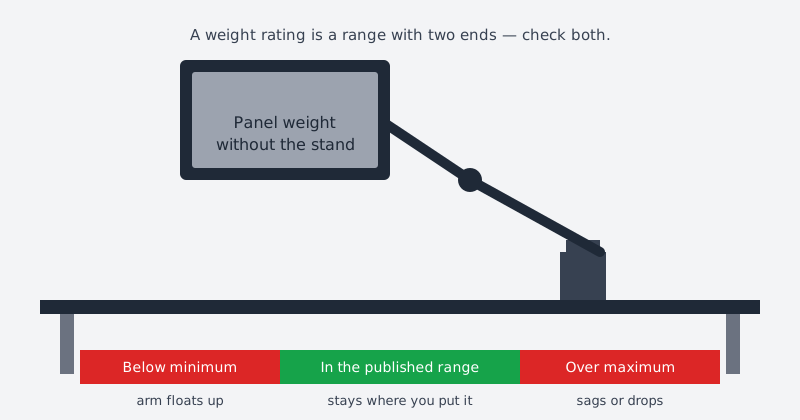
A weight rating is a range, not a ceiling — below the minimum the arm floats up, above the maximum it sags, and only inside the published range does it stay put.
First, weigh the panel — without the stand
The arm carries the panel alone, so the stand’s weight does not count — and the difference is large enough to change which arm you buy. Dell lists the 38-inch U3824DW at 29.25 lbs with stand and cables, but 19.37 lbs without stand and cables (per Dell’s own spec page). Shop by the with-stand figure and you will buy a heavier arm than you need; shop by the shipping-box weight and you may rule out arms that would fit fine.
Use the monitor manufacturer’s spec page or manual — look for the line that reads “without stand” or “panel only.” Retailer listings often quote the boxed weight instead.
Cables count against the arm, not the stand. The with-stand figure above bundles cables in; the without-stand figure excludes them. A cable or two will not tip a well-matched arm, but it is one more reason to leave margin under the ceiling rather than sitting exactly on it.
If the spec page gives only one weight, assume it includes the stand and look for the manual, which usually breaks the figures out. Samsung lists the Odyssey OLED G9 (G93SC) at 8.8 kg (19.4 lbs) without the stand and 12.6 kg with it — the same panel, two very different numbers.
A weight limit is a range, not a ceiling
Most buyers read only the maximum. But tension-balanced arms — gas-spring and constant-force designs — must be matched to the load in both directions, so they publish a minimum as well. Ergotron’s own LX manual puts it plainly: if the mounted weight is too light, the product “does not stay down when lowered,” and the fix is to decrease lift strength; if it is too heavy, it “does not stay up when raised.” An arm that is too strong for its monitor is a real failure mode, not a safety bonus.
Pole-style arms are the exception: they hold position with tightened joints along a fixed pole rather than floating on a spring, so they publish a maximum only and there is no minimum to miss. The VIVO STAND-V001, for example, is rated up to 22 lbs with no minimum published.
Published weight ratings of four monitor arms: Ergotron HX, Ergotron LX, HUANUO FlowLift Pro, and VIVO STAND-V001
Arm
Screen size rating
Weight rating
Mechanism
VESA
Ergotron HX (45-475)
Up to 49″
20–42 lbs
Constant-force
75×75, 100×100, 200×100, 200×200
Ergotron LX (45-241)
Up to 34″
7–25 lbs
Constant-force
75×75, 100×100
HUANUO FlowLift Pro
Up to 32″
Up to 19.8 lbs (maximum only)
Mechanical spring (MechaSpring)
Not published on the product page
VIVO STAND-V001
13–32″ standard, up to 38″ ultrawide
Up to 22 lbs (maximum only)
Pole / clamp joints
75×75, 100×100
Two things to notice in that table. First, the FlowLift Pro’s product page publishes a maximum only — 19.8 lbs — with no minimum, no VESA pattern, and no desk-thickness range on the page itself. A missing minimum is not a zero minimum; it means the maker has not told you where the floor is, so treat the top of the range with extra care. Second, the HX’s floor is higher than the LX’s ceiling is low: the two ranges overlap only between 20 and 25 lbs. Panels outside that overlap force a real choice between arm classes.
Three real monitors, four arms: where the numbers land
Putting manufacturer-verified panel weights against the arms above shows how often the answer is surprising — and how often the expensive arm is the wrong one:
Three monitors checked against four monitor arms using manufacturer-published specifications
The Dell and the Samsung are the same weight to the tenth of a pound, and both land in the gap between arm classes: too light for the heavy-duty HX, nearly at the ceiling of the FlowLift Pro. That 0.4-lb margin on the FlowLift Pro is not a comfortable fit — cables, imperfect tension, and a panel that is a fraction heavier than spec all eat into it. The practical rule is to leave clear space under the maximum and above the minimum on tension-balanced arms, and to treat a panel sitting exactly at a published limit as a panel that needs the next arm up. No manufacturer publishes a percentage safety-margin rule, so this is editorial guidance, not a spec — but Ergotron does say it load-tests its arms to four times their rated capacity, which is the manufacturer-side reason a small margin is not a cliff edge.
One more LX-specific catch, straight from Ergotron’s manual: with monitors over 20 lbs, the LX’s vertical range of motion may be reduced by up to 4.5 inches. A 22-lb panel that technically fits the LX may not travel as far up and down as a lighter one.
What the size rating does and does not promise
The diagonal-inch rating on the box is a rough proxy, not the binding constraint. Ergotron’s own HX brochure says the listed LCD size “may be exceeded as long as screen weight does not exceed maximum weight capacity of the mount.” Weight is the binding limit; the size rating is a shorthand for the panels the maker had in mind when it set that weight range.
That does not make size irrelevant. A 49-inch panel is nearly four feet wide, and width creates leverage and swing clearance the weight figure says nothing about. The size rating is worth checking after the weight check passes — particularly for ultrawides, where the panel’s width and curve change how the load sits on the arm. Our ultrawide monitor-arm guide covers those checks in detail.
The mounting interface
VESA pattern is a fit check, not a weight rating
It is easy to assume the VESA pattern — 75×75 or 100×100 mm — tells you how much weight the mount can take. It does not, at least not in the way most people mean. The VESA FDMI/MIS standard does set a maximum display weight for the mounting interface itself: 8 kg (17.5 lbs) for the 75×75 mm MIS-D pattern and 14 kg (30.8 lbs) for the 100×100 mm MIS-D pattern, per summaries of the standard (the full FDMI specification is a paid document, so we cite the published summaries rather than the standard itself). But that is a display-side requirement — what a display’s mounting interface must be built to support — not an arm rating. Arms routinely exceed it: the Ergotron HX is rated to 42 lbs while the display interface stays MIS-D.
Confirm the monitor’s pattern on its spec page. Most 34–49-inch ultrawides use 100×100 mm, including the Dell U3824DW and the Samsung G93SC per their manufacturers — but verify, because some large panels use 200×100 mm instead.
Confirm the arm includes that pattern. The HX covers 75×75 through 200×200 natively; the LX and the STAND-V001 cover 75×75 and 100×100. HUANUO does not publish a VESA pattern for the FlowLift Pro on its product page, so do not assume one — check the manual before ordering.
If they differ, budget for the arm maker’s adapter plate (for example, Ergotron’s VESA Bracket Adapter Kit 97-759) rather than improvising with third-party plates — the plate is part of the load path.
Curved and deep panels
Curves and depth change the effective limit
Weight is not the only load variable the manufacturers warn about. Two published specifics:
Deep monitors may lose capacity. Ergotron’s HX product page notes that display depth greater than 8 inches “may affect the arm’s weight capacity.” A thick panel moves its center of gravity farther from the mount, which is leverage the weight figure alone does not capture.
The heaviest ultrawides get their own variants. Ergotron sells the HX with a Heavy-Duty Tilt Pivot (45-647, rated 28–42 lbs) and a Very-Heavy-Duty Pivot (45-693, rated 28.7–37.5 lbs) for its heaviest setups, including the 57-inch Odyssey G9. If the manual names your model and a variant, treat the variant as part of the requirement, not an upsell.
The desk is a separate weight check
The arm’s rating answers one question — can the arm hold the panel? — and says nothing about whether the desk can hold the arm. A 27-lb panel on a 42-lb arm still concentrates the whole load — panel plus arm — at one small clamp point on the desktop edge. That is a desk question, not an arm question:
Clamp fit: the HX clamp accepts 0.4–2.6-inch desktops; the LX clamp 0.4–2.4 inches; the STAND-V001 clamp up to 3.25 inches. Measure your desktop and stay inside the arm’s published range.
Desktop material: thin, hollow, or glass desktops concentrate a heavy panel’s load badly. HUANUO recommends wood desks for the FlowLift Pro. If your top is thin or soft, a reinforcement plate spreads the clamp load — and some desktops simply should not carry a 25–30-lb panel on one clamp.
Mount style: a grommet hole spreads the load through the desktop rather than pinching the edge. The clamp-vs-grommet guide covers the tradeoffs, including the edge access a clamp needs underneath.
What happens when the numbers do not match
The failure modes are different on each side of the range, and the manufacturers describe both:
Too heavy: the arm cannot hold the panel where you put it — it droops, sags, or will not stay raised. HUANUO’s maintenance guidance says a drooping monitor “often means the arm can’t support its weight properly” and the first check is whether the monitor’s weight matches the arm’s specifications. VIVO’s manual is blunter: “DO NOT EXCEED WEIGHT CAPACITY… FAILURE TO DO SO MAY RESULT IN SERIOUS INJURY.” If the panel is over the maximum, do not mount it — choose a heavier-rated arm or keep the stock stand.
Too light: a tension-balanced arm cannot balance down to the load, so the monitor drifts upward no matter how you set the tension. Ergotron’s LX manual says the fix is to decrease lift strength — and if the panel is below the published minimum, no adjustment will close the gap.
Removing the monitor: the arm mechanism is under tension and “will move up rapidly on its own as soon as attached equipment is removed,” per Ergotron’s LX manual, which instructs you to move the arm to its highest position before removing equipment. Treat an unloaded tension arm as a loaded spring, because that is what it is.
Know when to stop
When not to arm-mount a monitor
The panel exceeds the arm’s maximum
A 27.8-lb panel on a 19.8-lb arm is not a borderline case — it is a drop waiting to happen. Over-limit mounting is the one mistake with no cheap recovery.
The panel is under the arm’s minimum
A tension-balanced arm cannot balance below its floor. A 19.4-lb panel on a 20-lb-minimum arm will drift upward no matter how you set the tension.
The desk cannot take the concentrated load
Glass tops, thin hollow-core slabs, and clamped edges over drawers concentrate a heavy panel on a weak point. The stock stand spreads the load — keep it until the desk is upgraded.
The quick fit checklist
Find your panel’s weight without its stand on the monitor manufacturer’s spec page or manual — not the box, not a retailer listing.
Match the arm’s full weight range, not just the maximum. Stay comfortably under the ceiling and above the minimum on tension-balanced arms; treat a panel sitting exactly at a limit as a panel that needs the next arm up.
Check the size rating after the weight check. The rating may be exceeded on weight alone (per Ergotron), but a 49-inch panel still needs an arm actually rated for it — most mainstream arms stop at 32″.
Confirm the VESA pattern on both sides. 100×100 mm (MIS-D) is typical, but verify the monitor’s spec page and the arm’s pattern list; budget for the maker’s adapter plate if they differ.
Curved or deep panel? Read the curved guidance. Look for a lower curved weight ceiling or a required tilt variant in the manual, and note that display depth over 8 inches may reduce the HX’s effective capacity.
Verify the desk. Clamp or grommet within the published thickness range, clear rear edge underneath, and a desktop material the maker approves — add a reinforcement plate for softer or thinner tops.
If any check fails, pause. A mismatched arm risks the panel itself. The stock stand is a fine mount while you find an arm that passes every check.
Go here for routing that survives an arm’s full travel — edge-mounted ports on wide panels need more slack than you expect.
Sources and verification
Primary references
Monitor and arm specifications below are from the manufacturers’ own pages and manuals, verified November 5, 2026, except where noted. No retailer prices, ratings, or review data were used. These are non-affiliate references.